November 2026: Hiking Straight Out of the City
Bogotá is located on a high mountain plateau in the Andes, 8,660 feet above sea level. Even the mile-high city of Denver, Colorado, nestled way up in the Rockies, is only 5,280 feet above sea level, and Seattle, my former home, rings in at around 175. When lifelong lowlanders like me first arrive here, the altitude presents an array of minor health complications: getting out of breath just walking down the street, feeling sleepy for no good reason, and a nagging headache. People who were born and raised here have powerhouse lungs and don’t even notice that their air is short on oxygen, but the rest of us have to acclimate. Supposedly it takes two or three days... But nearly a month after our arrival, I was still getting winded just walking up the little hill between the grocery store and our AirBnB. Had my hiking muscles withered away to nothing in the weeks since leaving the Pacific Northwest, or was I just taking longer than usual to adjust to the altitude?
How would I be able to perform here (if and when I finally found some local musicians to sing with), if I couldn’t even catch my breath?
And how the heck was I going to handle our upcoming trip to Chingaza, the Colombian national park high in the Andes where we planned to spend three days hiking and exploring?
I had tried hiking here before. The eastern edge of Bogotá runs right up against the mountains — going from crowds and cement to a lonely trail through seemingly-untouched forest within the space of three blocks — and the city boasts several trails leading up and out of the urban environment, all managed by the municipal water company. Years ago, on one of our 10-day visits to Bogotá, my husband A. and I had tried hiking the Quebrada la Vieja trail at the eastern end of calle 71. Back home in the Pacific Northwest we are a well-matched hiking duo: experienced weekend hikers with good stamina and strong legs, we keep up with each other. But at Quebrada la Vieja I was left gasping far behind while he looked back in confusion, barely winded. Strong bogotano lungs and a limited need for oxygen, even after 20+ years out of the country. Humph. We both laughed about it at the time, but in my heart of hearts I felt like a wimp.
Fast forward to last month, when a Colombian-American cousin from North Carolina came to visit. She had planned the trip to Chingaza for the three of us, and scheduled her flights around it, so there was no backing out. Parque National Natural Chingaza is big, and ranges from small potatoes (2,600 feet) way up to big potatoes (13,200 feet) in altitude. Our group would primarily be visiting the paramos: remote alpine plateaus located high in the Andes. So in the week before the departure date, I worried. Would I even be able to enjoy the trip, or would I collapse at the beginning of the first hike and have to be left behind in the cabin, wheezing, while they had fun without me?
In Colombia, a lot of the national parks (including Chingaza) can only be visited with a guide. We had two: Leidy, who did the talking, and Hector, who drove. Leidy told us that education about good park etiquette and what not to do in the Great Outdoors—the “give a hoot, don’t pollute” and “don’t trample the wildflowers” messaging that’s become part of popular culture in the US—is still pretty new in Colombia. Those kinds of public education campaigns take money, and they take time. Meanwhile, the rangers and guides looking after Colombia’s most fragile national parks don’t want people to trash them due to lack of knowledge. Hence the guides. There are also some pretty stringent rules, like no single-use plastics in the park. The ranger at the park entrance even searched our backpacks! She okayed the ziplocks we’d packed our toiletries in, since they were clearly destined for multi-day use. But we also had juice boxes with us, the kind that you put in kids’ lunchboxes, with little plastic-wrapped straws glued to the sides. The boxes and their straws—which were made of paper—passed muster, but we had to remove the plastic from around the straws and put it in the trash before Hector was allowed to drive us into the park.
Hector was a gentle giant with an uncanny ability to navigate the heavy van smoothly along the narrow, twisty dirt roads, dodging rocks, potholes, mudslides and other vehicles with equanimity. He didn’t talk much, but he had an eagle eye for spotting distant birds, bears and deer crossing the paramo, and a shy smile that was absolutely endearing on such a big man. Leidy was a small woman, but strong and feisty. She was a true storyteller, and full of highly contagious passion for Chingaza and the surrounding farmlands where she had grown up and spent most of her life.
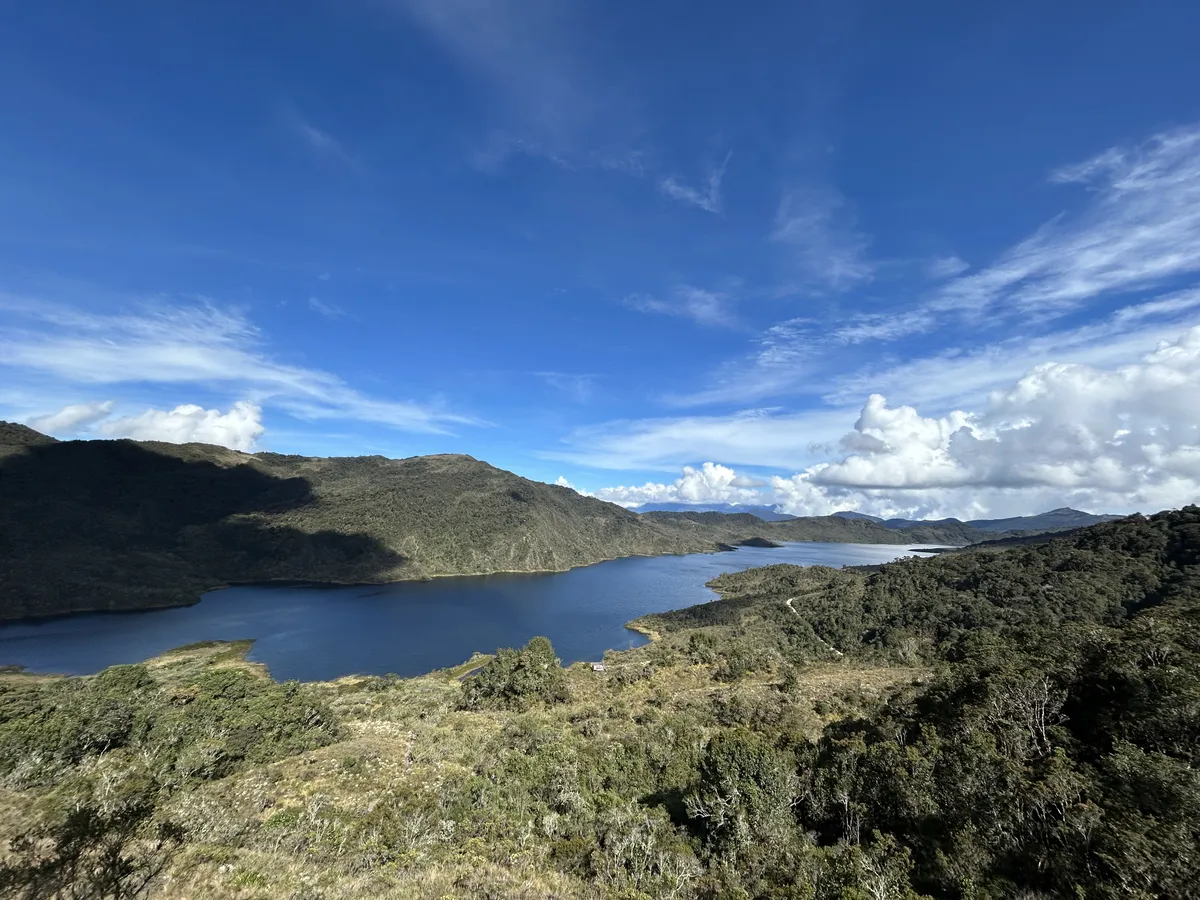
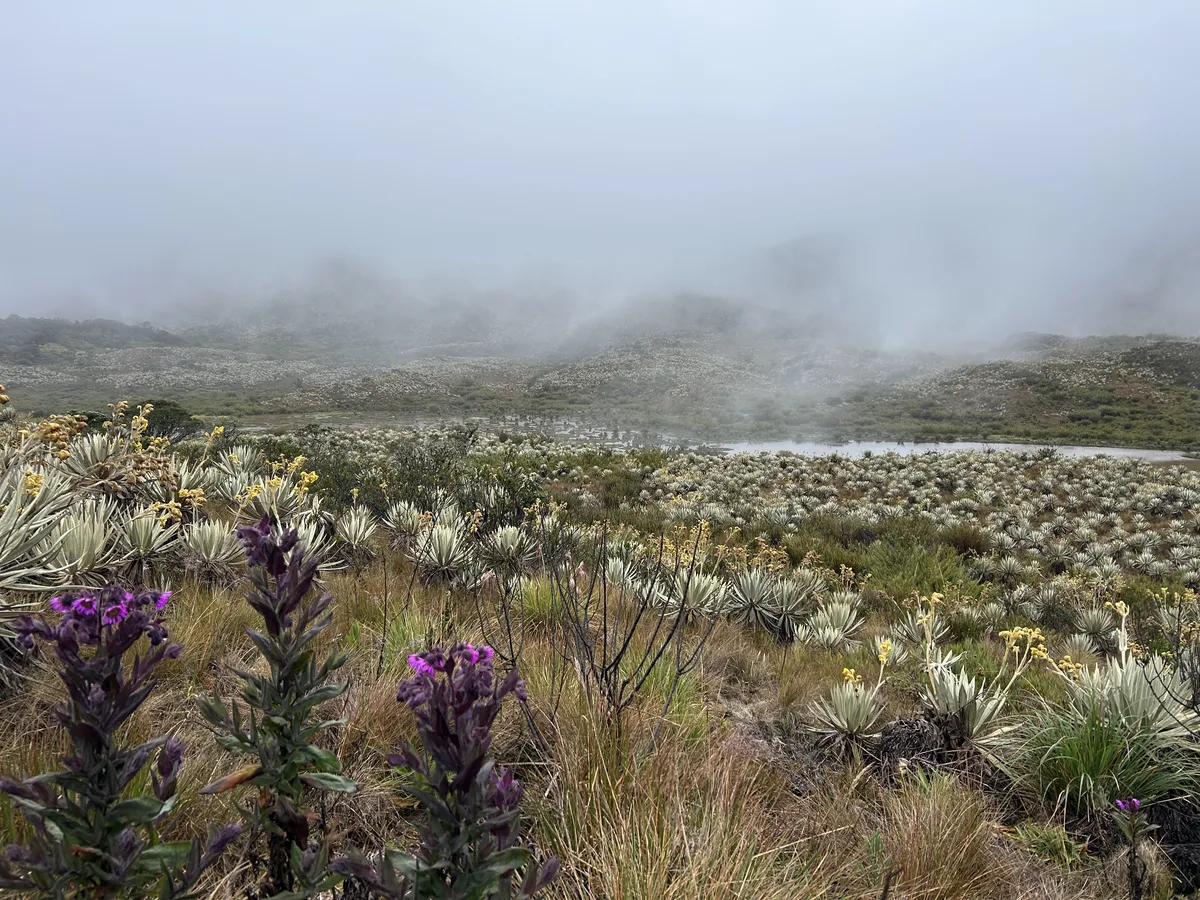
That first day, we saw an abandoned quarry that once supplied most of the gravel used to build Bogotá, and hiked through a beautiful section of bosque alto Andino (high Andean forest). The next day the park road climbed higher and higher, until we were well above treeline: that’s where the altitude becomes too much for trees to handle, so they don’t bother trying and instead leave the paramo to the stubbier plants that thrive there. We hiked through high Andean wetlands and around Laguna de Chingaza, the lagoon that supplies 80% of the drinking water for Bogotá and its suburbs. Laguna de Chingaza and the other lagoons in the park are crystal-clean thanks to the frailejónes and other paramo plants that capture, store and filter water from the thick mist in the air and the abundant rainfall.
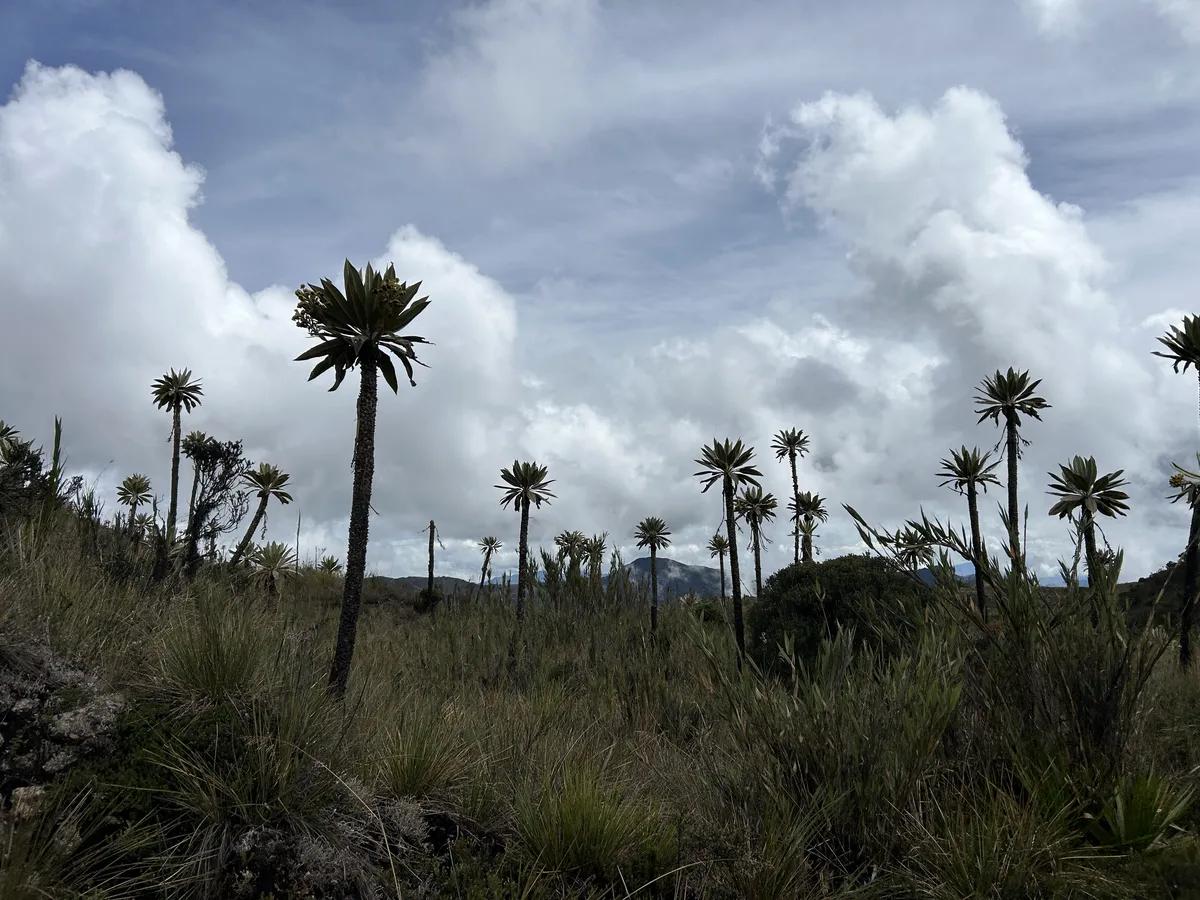
About the frailejónes: There are five different species in Chingaza, and they are magical. Some have tall trunks and look like little palm trees. Others are stubby, with their trunks hidden under bushy layers of palm-like leaves. They were blooming while we were there, and the bright splashes of yellow flowers were like little headlights piercing through the fog. Leidy told us that the term frailejón comes from two Spanish words: “fraile” (friar) and “lejos” (distant). With their stout, shaggy shapes cloaked in the mist, they really did look like Friar Tuck and his brown-robed colleagues slowly crossing the paramo in the distance beyond the trail.
At the close of each day, and again in the morning for breakfast, the five of us ate together in the cafeteria at Monterredondo (the park’s only campground). That first night the fresh mountain air had sharpened my appetite, and I devoured my grilled chicken and mushrooms like an Andean bear. But A. ate slowly, wincing from a bad toothache that had started on the drive into the park and was getting steadily worse. His South Carolina cousin had only been in Bogota for a few days before we left—not long enough to acclimate, as it turns out, and with the even higher altitude in Chingaza she suffered from a stubborn headache throughout the trip. Meanwhile A’s toothache kept getting worse, until we finally had to rush back to Bogotá half a day early for an emergency dental visit and root canal.
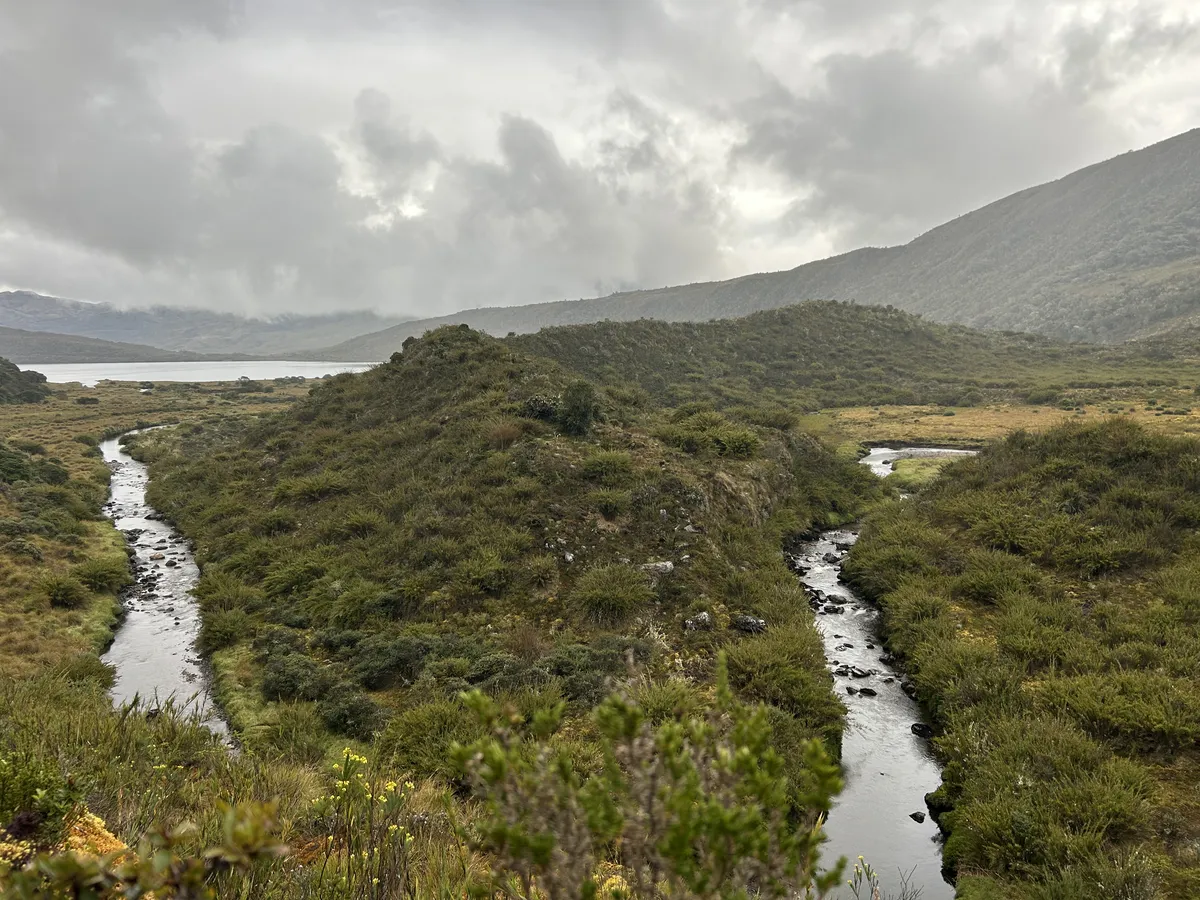
That part was rotten. I was amazed at how patient and good-humored they both were throughout the trip, despite the constant pain. But when I wasn’t worrying about them… I felt great! As I slurped and squelched my way along the muddy trails in my rented rubber boots, soaking up the eerie beauty of the dark lagoons and watching the frailejónes and purple arnica appearing and disappearing in the mist, my lungs whooshed the mountain air through my system as efficiently as if they’d been living on half-rations of oxygen all my life. Why had I been so worried? None of the hikes were very steep, even if they were at a higher altitude than I’d ever reached before outside of an airplane.
On the drive back to Bogotá, Leidy showed me a video of a cartoon frailejón named Ernesto Perez who teaches Colombian kids to save water and use less electricity. The video shows him skipping around the paramo and singing to a little kid in frailejón pajamas. I just about laughed my head off:
After my comparative triumph in Chingaza, I was ready to try hiking out of Bogotá again. Moving Day arrived first, though: We finally found our own (rented) apartment, no more drafty AirBnB for us! Once we’d re-packed all nine suitcases, trucked them over, and settled in, we set out to explore our new neighborhood and discovered that the Santa Ana La Aguadora trailhead is only a 15-minute walk from the door of our new building. A-ha!
Because security is an ongoing issue in Bogotá, Santa Ana and the other city-adjacent trails are only open to the public on certain days and at specific times. During open hours, trailheads are guarded by city police officers serving as trail guides. The police-guides are also stationed at the end of the trail, and usually at a strategic point or two partway up. Before you’re allowed to hike, you have to show proof of your reservation (a free app lets you reserve a hiking slot). Having to make a reservation and then be ushered past a big metal gate before entering the forest seemed weird and cumbersome to me at first. On the flipside, not having to worry about getting robbed or assaulted was definitely a plus, and the reservation system keeps the trails from getting too crowded.
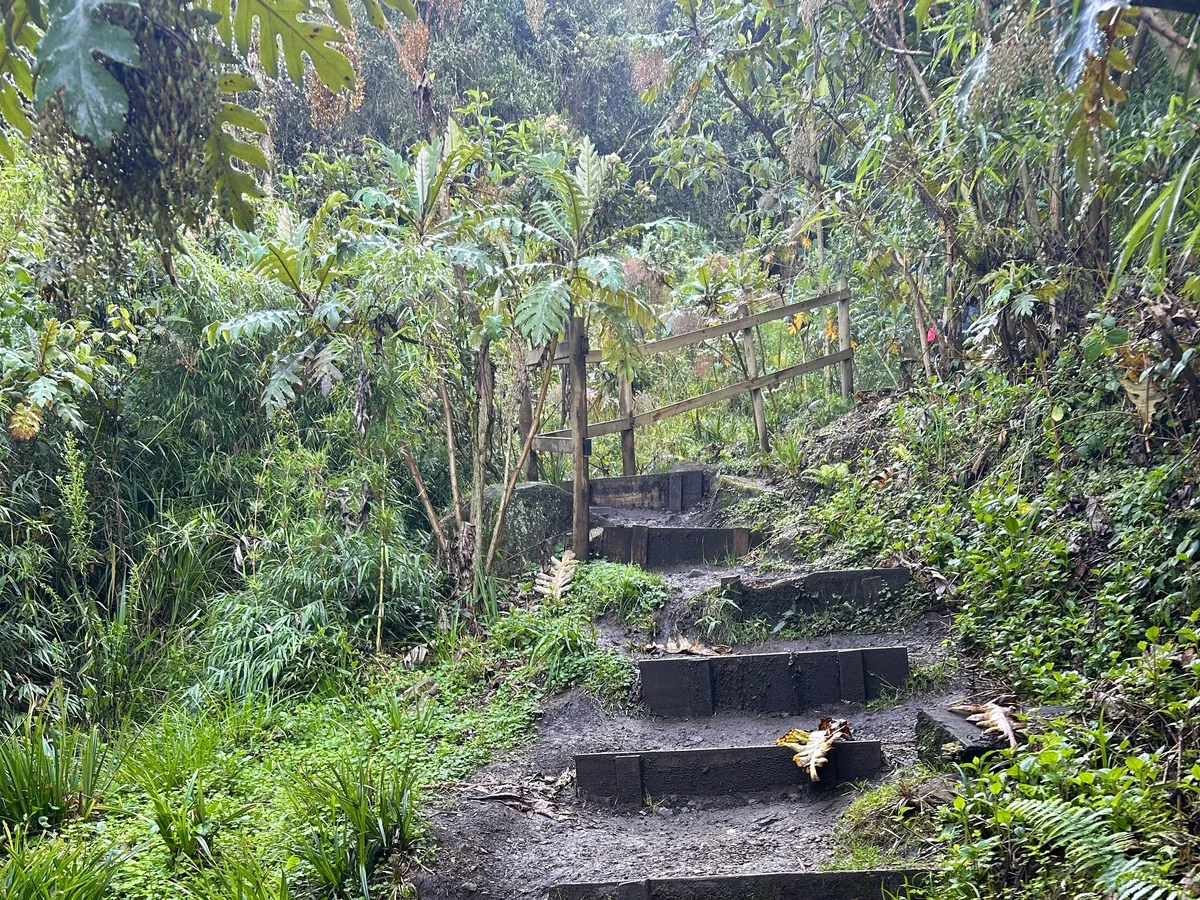
Even so, Santa Ana la Aguadora is not for the faint of heart. The city basically stops where the land becomes too vertical to build on, which means it’s pretty vertical for hiking too. Lowlander transplants such as myself must push our feeble lungs to the utmost to haul ourselves up the Santa Ana trail. It doesn’t help that the trailbuilders apparently weren’t fans of switchbacks: the trail goes STRAIGHT UP, and while it does feature lots of rough-hewn steps, my knees and lungs were howling before I was halfway to the top. Also, I had to hustle to make it to the mirador at the end of the hike, because the trail closes for the day at 11am, and the police-guides turn hikers around and, kindly but firmly, send them back down the trail when the hour approaches.
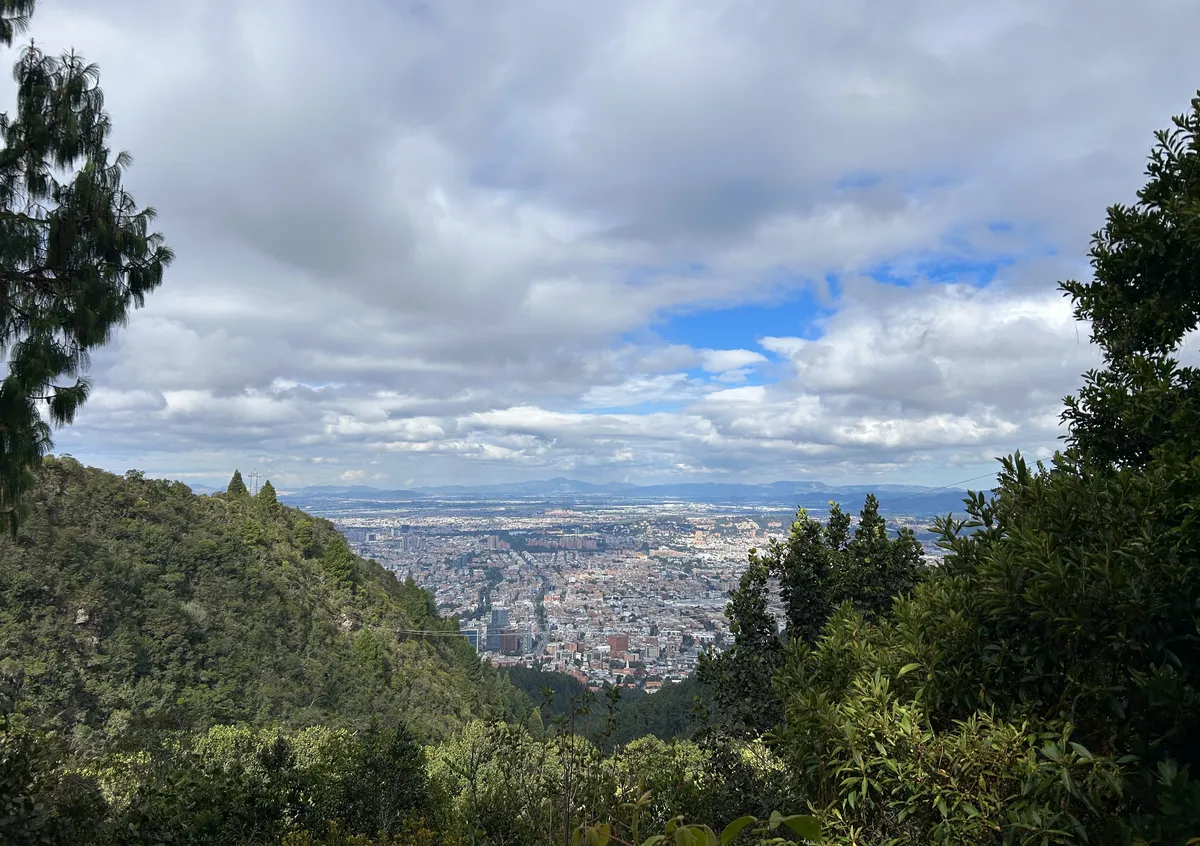
But the trail was frequented by butterflies and surrounded by thick-growing Andean forest, and the path was pristine: no discarded Kleenex or candy wrappers to be seen anywhere (who would dare to litter with police-guides nearby?). And the view from the mirador was so tranquil that, gazing down at the distant city below, it was hard to believe that all the honking and shouting and engines gunning from earlier that morning was real. Another plus: When I got to the top of the trail, to my surprise there was a guy there under a blue canopy, selling fresh-squeezed mandarin orange juice and grilling arepas for hungry hikers. How did he pack the pitchers and the fruit and the grill and the arepas and the canopy all the way up the trail, when it was all I could do to drag myself and my water bottle up those last 500 soul-crushingly steep meters to the summit? Bogotanos. Lungs of steel.
I went back the next Friday. And the next. And I’ve already made my reservation for tomorrow at 7:30am. When I get to the top, I’ll buy a cup of mandarin orange juice from José, the guy with the blue canopy (it turns out he lives on a mountain farm nearby, so he only has to cart his wares about 600 meters through the woods, along a very flat trail that goes straight from his kitchen to the mirador). Then I’ll sit on the little wooden platform, take in the view as I sip my juice, and allow myself to feel just a little bit triumphant. Watch out, altitude, there’s a new lowlander in this city, and she’s adapting to you with everything she’s got!