September-October 2026: Welcome to Bogotá
I’ve been in Bogotá for almost two months now, following half a year of increasingly crazed and stressful preparations for the move: Foisting nearly all my worldly belongings off on friends, neighbors, Facebook Marketplace users, and the Silverdale Goodwill. Selling the cars. Trying in vain to sell the house (anybody out there want to buy a big, beautiful home in the woods up the world’s steepest, twistiest driveway in unincorporated Kitsap County, Washington?). Neglecting my day job as a freelance French > English translator in favor of planning and attending goodbye get-togethers. Singing in my farewell concert with the band. Acting in my final children’s theater performances (will I ever tread the boards as a cat astronaut or bayou butterfly again?). Visiting my parents for the last time this year, which was the hardest part.
Finally getting those nine bulging suitcases checked and watching them disappear down the conveyor belt was profoundly satisfying (Yes, nine! Because there are two of us, staying for at least a year, and paying for extra baggage is way cheaper than paying shipping to Colombia). And stepping onto the plane felt as if a thick, fraying cord I’d been pulling on for months had finally snapped. A huge relief, but also a huge question mark: What comes next?
I decided to leave the United States for several reasons: I was close to hitting a dead-end in my performing arts career, and had come to the brutal realization that most of the projects I’d been blindly pursuing for so long no longer brought me joy. My marriage to the person I admire, love and delight in most in the world was on the verge of collapse, due to neglect and a shared but unacknowledged frustration with our lives. And I was horrified by my birth nation’s reelection of a morally bankrupt president, the subsequent dismantling of our democracy, and the repartition of its citizens into two deeply polarized sociopolitical camps that are utterly and completely unable to have a civil discussion together.
But I also had positive reasons for moving to Colombia: My husband is Colombian, and after 19 years of living in the US near my family, it was definitely his turn to get to live near his. I’ve been studying Latin American Spanish (my third language) off and on for years, and as a language junkie I relished the idea of using it on a daily basis and finally nailing down a respectable level of fluency. I love learning about and absorbing other cultures and their views on life and the world we share, and Colombia’s culture is enticingly rich and complex. And lastly, the avocados are delicious.
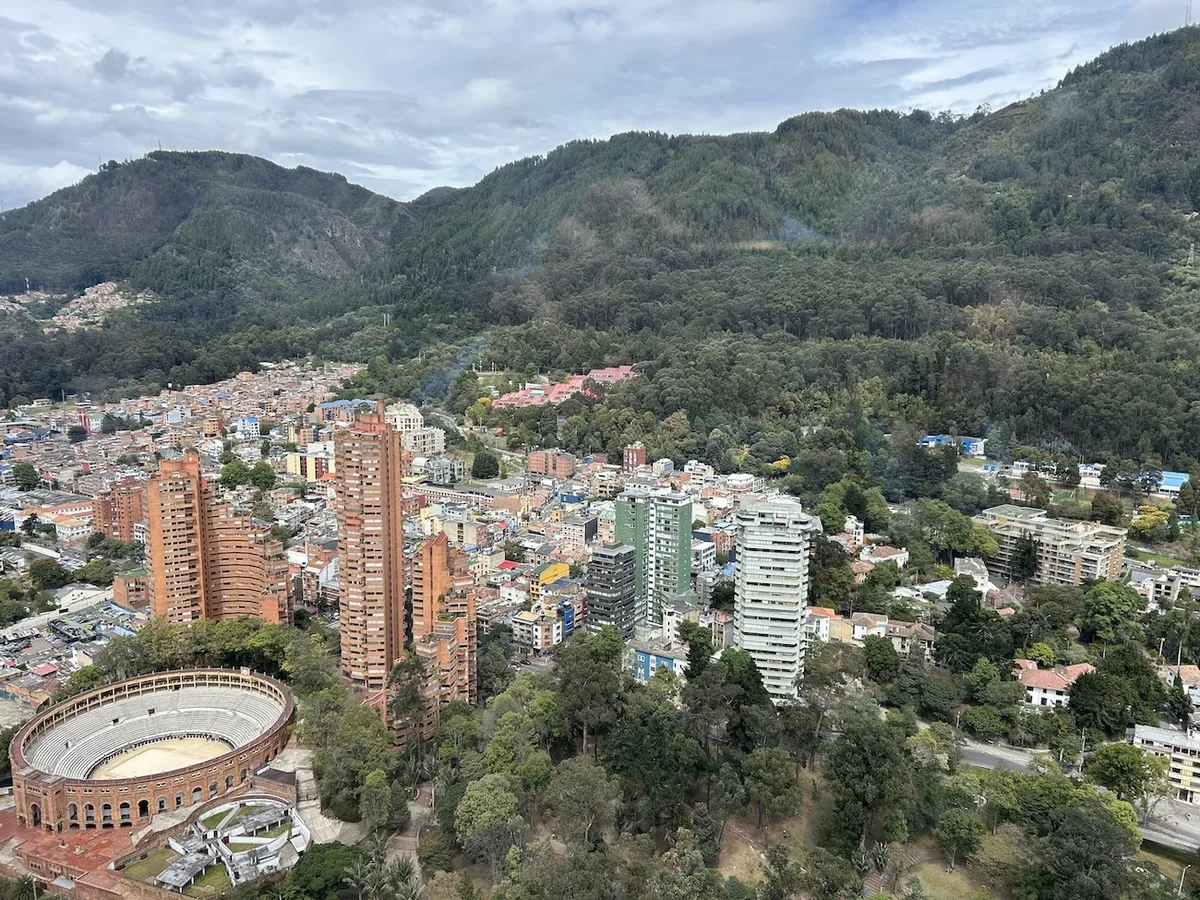
I’ve been visiting Bogotá with my husband for years, and have always both loved and been overwhelmed by the 10-day whirl of our visits, filled with salsa and vallenato music, buñuelos, ajiaco and granadillas to eat, and his wonderful, wacky, energetic, loving family. But I’ve never been any good at describing Bogotá after these visits, or even putting all my scattered, sometimes contradictory impressions together into some kind of general opinion, because Bogotá is just SO MUCH. Good and bad. Scary and delightful. Inspiring and incomprehensible, and very occasionally, when I least expect it, familiar.
Bogotá is overflowing with energy. The air buzzes with ideas and projects and hacks and swindles and deals, innovation and laughter and creativity and determination. The scruffiest, skinniest man I’ve ever seen leaps out in front of six lanes of barely-stopped traffic to juggle, or hurls a cord across the road to a waiting friend and skips along above the cars on his makeshift tightrope before making a swift round of driver-side windows for tips, half-seconds before the light changes. Downtown in El Centro there are vendors everywhere, tarps and blankets covered with goods spread out along the street and bike paths, food carts advertising cheap hamburgers and arepas and fresh-made passionfruit juice. There are indigenous women and their families with piles of hand-crocheted mochilas, modern-day hippies with elaborate displays of beaded necklaces, antiques dealers with everything from Victrolas to old bus signs, grandpas with trays of penny candy or display boards covered in lottery tickets, all hawking their wares with varying levels of showmanship and desperation. Recycling collectors roll their heavy carts slowly along the bike path, oblivious to the cyclists trying to dodge around them, and couples with baby carriages add obstacles by stopping to buy an arepa or a lottery ticket, or to greet their friends and chat.
Bogota is gritty. It’s full of dirt and noise, crowds, treacherous sidewalks, bad traffic, the cement-crushing rumble of road work, the bone-shaking rattle of construction projects. Some buildings have been half-finished for years, abandoned by unscrupulous entrepreneurs or still waiting on stalled paperwork and sign-offs. The urban rivers are thick with sludge, and old tires and trash are scattered along their retaining-wall banks. That said, they are cleaner than they were 20 years ago, when I first started visiting Bogotá: environmental consciousness is expanding, along with a passion for and well-deserved pride in Colombia’s astoundingly diverse flora and fauna. But old habits die hard (especially budget-friendly ones like chucking garbage into the river instead of paying to have it carted away), and the water beneath the bridges still stinks.
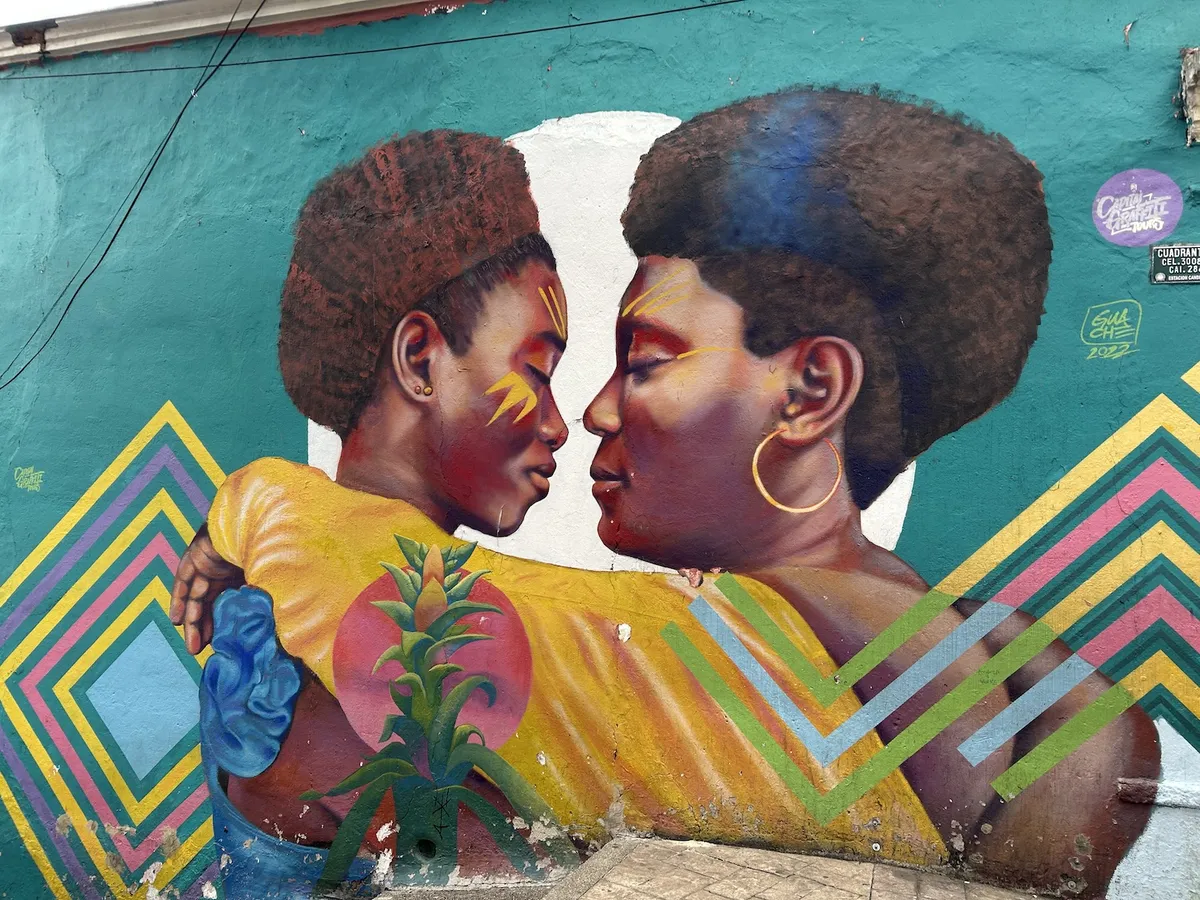
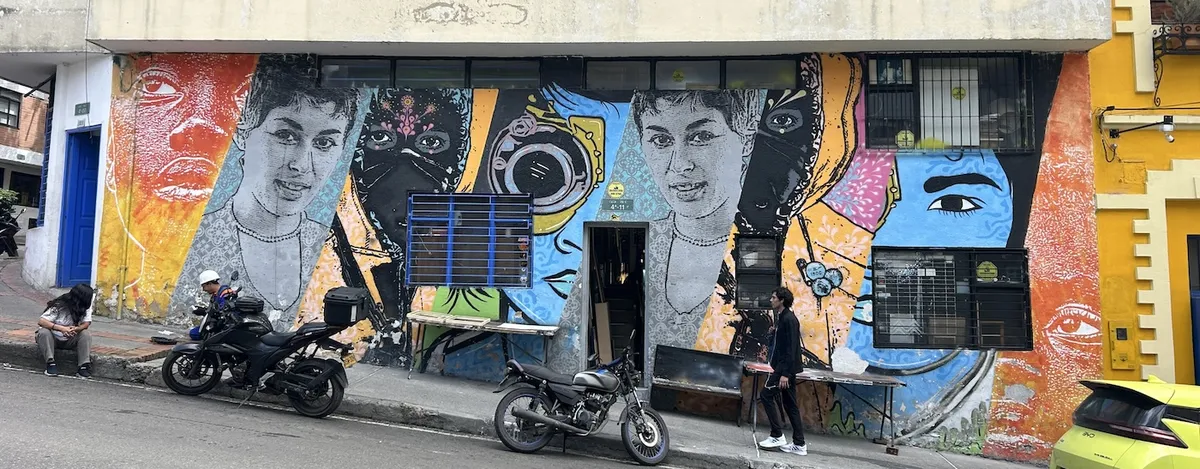
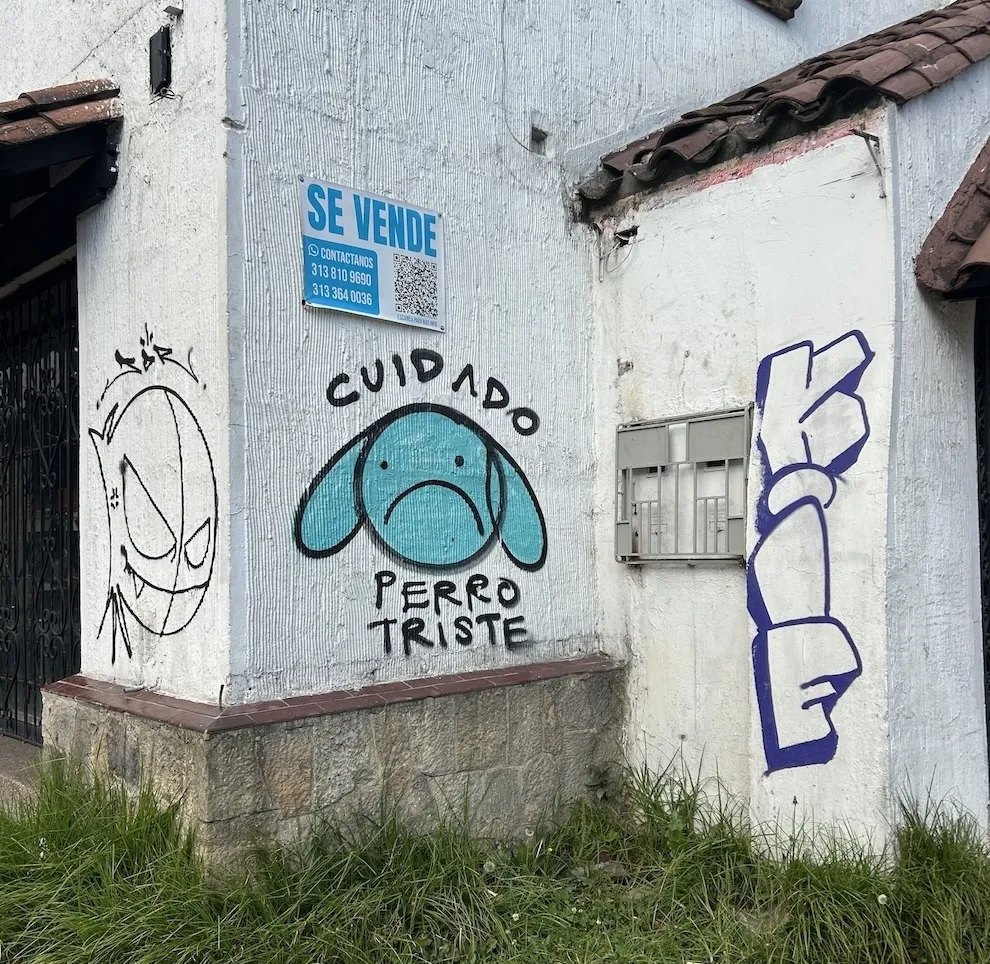
Bogota is full of color, ingenuity and unexpected beauty. Hundreds of artists, often nameless, have covered the sides of buildings, the traffic barriers, the concrete riverbanks with the real and imagined images that populate their worlds. Last week I turned a corner and was stopped in my tracks by a five-year-old indigenous girl painted ten feet high on an old brick wall, an expression of utter longing in her eyes, resignation in the dip of her shoulders. A few days before, I was just as moved by a mural of an old man clutching the handle of his plow, hat jammed down tight on his head. Near the Chorro de Quevedo I swoon over two Afro-Colombian women on the side of a two-story, colonial-era building, faces and clothing decorated in bright geometric shapes, inches away from a passionate kiss. Beneath the roar of Bogotá’s traffic, machinery, and human chaos there is always, always the sound of birds singing, and although I rarely glimpse the birds themselves, their portraits are painted on the wide support posts of overpasses and the walls of corner stores and warehouses. In one, a toucan seems to wink knowingly at me. In another, a turquoise hummingbird dips its long, sharp beak sensuously into the magenta-pink of a tropical flower. There are murals of endangered animals, classic American movie posters meticulously recreated, abstract swaths of color and shape. There is also endless graffiti, tags that are repeated all down one neighborhood’s walls and into the next with mysterious messages. One of my recent favorites says Cuidado, perro triste! above a cartoony, round-faced sketch of a floppy-eared dog.
Bogota is elegant. In the upscale north it seems like everyone is a designer, and throughout the city everyone has an eye. From street signs to clothing to handmade furniture to found objects in harmonious colors dangling from the ceiling of a coffeeshop, people have a flair for making everyday places look at once boldly unique and seductively understated. Colombians seem to move through life with a deep-rooted dignity and self-respect, irrespective of where they land on the socioeconomic ladder. I’m convinced it’s that dignity that’s the foundation of their effortless elegance.
Bogotá really knows how to drive. Or really doesn’t, depending on your point of view. The city’s traffic jams are legendary, and about 30 years ago the congestion got so bad that the city instituted pico y placa, a strict road-space rationing program: Cars with license plates ending in 1,2, 3, 4 or 5 have to stay off the road half the time, and those ending in 6, 7, 8, 9 or 0 have to stay home the other half. They say that traffic is better now. I’m glad I never had to experience it before. These days, cars, trucks and buses of all sizes and in every imaginable condition cram and jam and honk and insist their way in and out of packed traffic lanes, while motorcyclists zip precariously in and out of the ephemeral spaces between them, passengers clinging to the seat bar or the driver in front of them. Pedestrians stand on the sidelines, waiting to reach critical mass before plunging into the street to cross in a group too big to be mowed down. Every driver is intently focused on their end goal, navigating the calles and carreteras with an unshakeable me-first approach to merging, determined yet fatalistic. There could so easily be accidents, everywhere, all the time, except that vehicles and pedestrians alike are so relentlessly alert and aware of every movement around them. Besides, between the congestion and the ubiquitous potholes, drivers seldom have enough space for speeding. Staring out the window of my rush-hour taxi in fascination, I think about how, for all that I have a perfect driving record back in the States, in comparison to bogotanos I drive half-asleep. In places where people actually stay within the lane markers (and there are lane markers), live in fear of traffic cameras and the highway patrol, and navigate more or less predictably along smooth, well-maintained roads (one of the perks of living in a wealthy country), there’s no reason to be so actively alert.
In fact, in my native land, the roads are tame, the people are tame, daily tasks are eased for us, and we tend to live life half-asleep. We firmly believe that we deserve to be comfortable! But how can we learn to be innovative and creative and resourceful when our lives so seldom demand it of us?
And can I learn to approach life that way, now that I’m here and doing my darndest to speak the language, be confidently alert on the streets, sing along to Cabas and Shakira on the radio, and order arepas from the street vendors with panache?